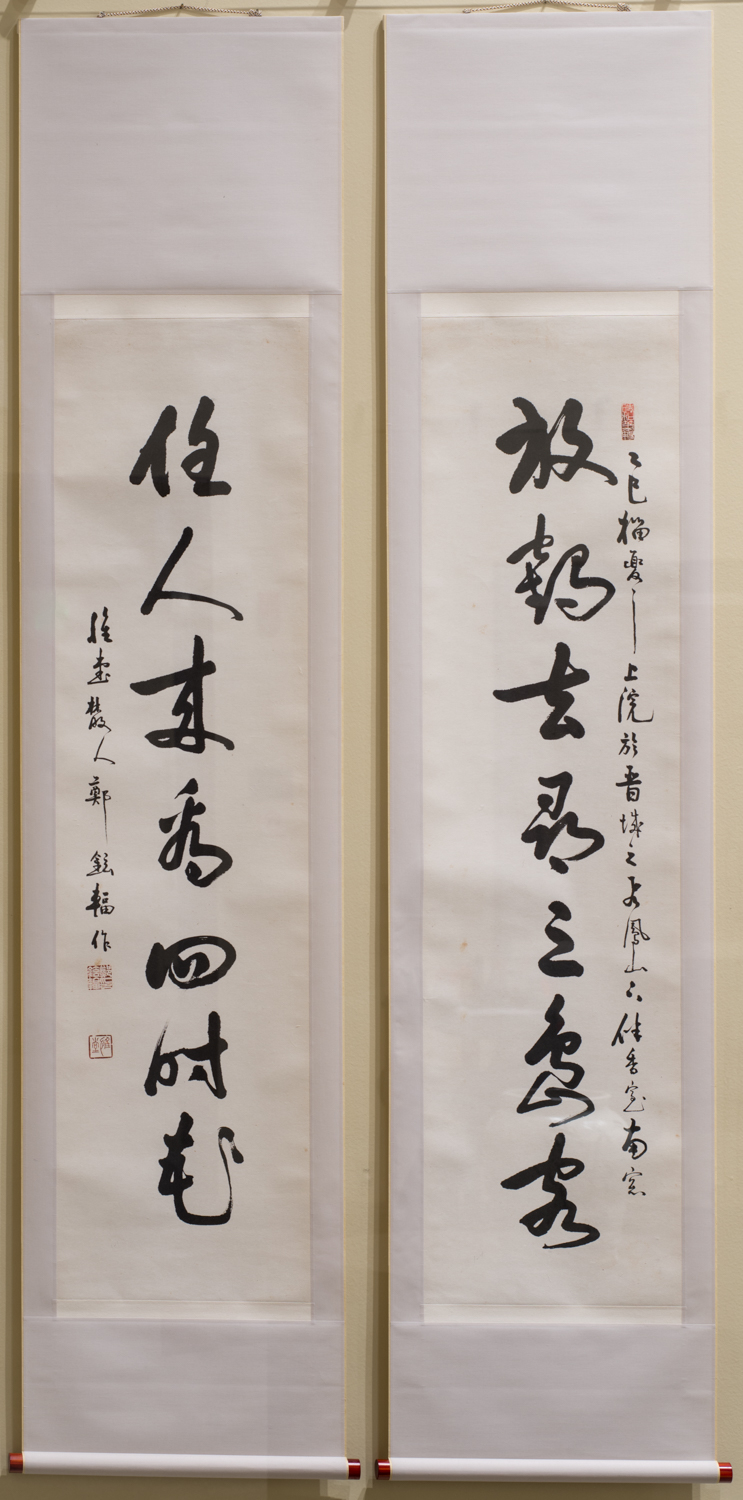
- Title
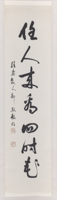
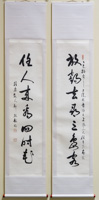
"Searching for Guests by Releasing a Crane..." (Korean, Bang hak geo shim sam do gaek / Yim in rae gan sa shi hwa; Chinese, Fang he qu xun san dao ke / Ren ren lai lan si sgi hua) - Artist/Maker
JUNG Hyun-bok 鄭鉉輻 정현복 (Yoodang 惟堂 유당) artist - Object type
calligraphy hanging scrolls
- Culture
Korean
- Date
1965
- Place Associated
Korea
- Materials
Pair of calligraphic hanging scrolls in Chinese characters; ink on paper
- Dimensions
H. 76 x W. 17-1/2 inches (H. 193.0 x W. 44.5 cm) (scroll a); H. 51-3/16 x W. 13 inches (H. 130.0 x W. 33.0 cm) (image a); H. 76 x W. 17-1/2 inches (H. 193.0 x W. 44.5 cm) (scroll b); H. 51-3/16 x W. 13 inches (H. 130.0 x W. 33.0 cm) (image b)
- Description
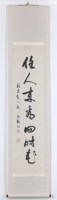
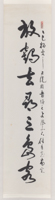
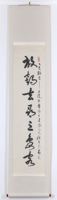
I release a crane to go searching for guests from the three sacred islands, Leaving flowers of four seasons in my empty hut for people to enjoy freely. Jung Hyunbok rendered this evocative verse in running Chinese script, ever so slightly varying the scale and height of each character to give an impression of strength and momentum. Jung Hyun-bok was an extraordinarily gifted calligrapher and Confucian scholar who demonstrated mastery of various brush modes ranging from traditional semi-cursive to modern experimental script. Born in South Gyeongsang province, he was a prodigy whose first celebrated calligraphy was produced at the age of three. In his late teens, Jung was perceived to have excelled beyond the student stage to produce works that demonstrated artistic and academic maturity. Moreover, he successfully re-elevated calligraphy to high status, after it had been severely undervalued. His rhythmic brushstrokes and elegant formations exemplify the calm discipline of a rightful successor to Joseon dynasty (1392-1910) literati but also represent an intelligent reinterpretation of tradition in tune with modern sensibilities. These two hanging scrolls show his long association with the
traditional donggujin cursive writing style first introduced by Wongyo (1705–1777) and Changam (1770–1847) in the seventeenth century. The poem “Searching for Guests from the Three Islands of the Immortals by Releasing a Crane” was composed by Qing-dynasty (1644–1912) Chinese poet YUAN Mei (1716–1797). Such classical Chinese poems were beloved by Joseon literati and memorized and perpetuated for both entertainment and self-cultivation.
放鹤去寻三岛客
任人来看四时花
Searching for guests from the Three Islands of the Immortals by releasing a crane Inviting people to see flowers of four seasons* *Translated by Gina Kim- Credit Line/Donor
Gift of JUNG Do-jun
- ID Number
2010:8.1a,b
- Location
In storage
- Exhibitions
Traditional & Contemporary Korean Art from the JSMA & Mattielli Collections
